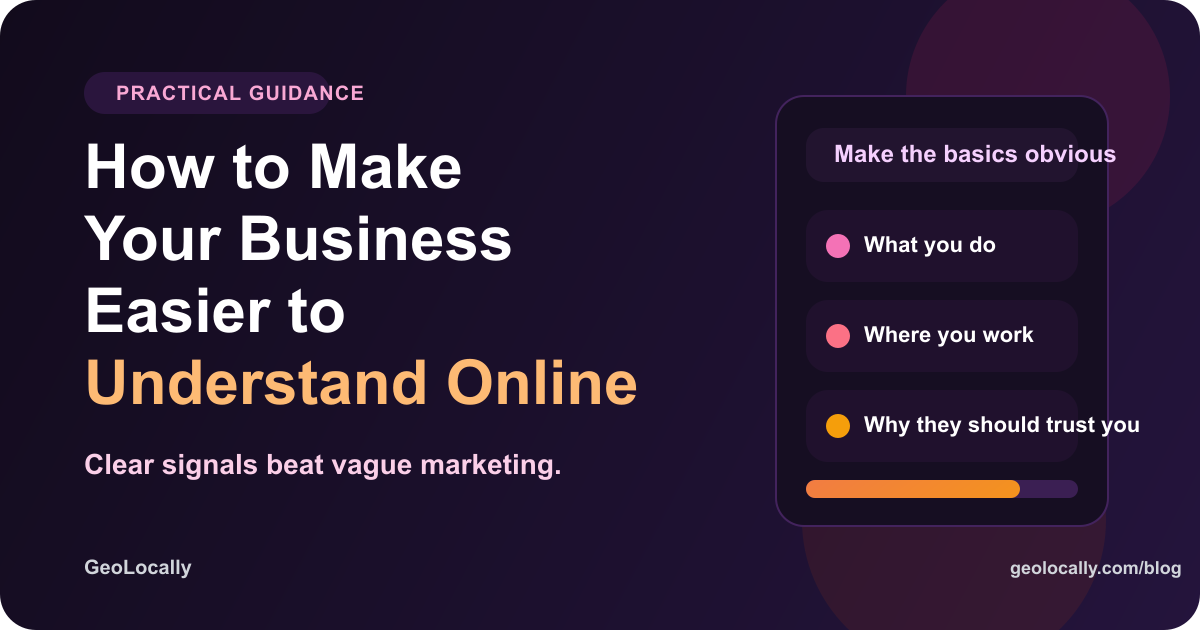
If you want people to understand your business faster online, start here:
stop making your business hard to understand online.
That may sound blunt, but it is the real issue. Most local businesses do not need cleverer marketing. They need clearer information.
Start with the basics
Google and newer search tools are trying to answer simple questions:
- What does this business do?
- Where does it operate?
- Who is it for?
- Does it look current and trustworthy?
If your website leaves those questions fuzzy, search has less confidence in how to categorize or show you.
1. Say what you do in plain language
Your homepage should not read like an agency award submission.
It should say what the business does in words a customer would actually use.
Bad: "Comprehensive modern solutions for your residential needs"
Better: "Roof repair and roof replacement for homeowners in Tampa"
The clearer the service language is, the better.
2. Be specific about location
"Serving the community" is weak.
"Serving Miami homeowners and small businesses" is better.
"Serving Tampa, Brandon, Riverview, and nearby Hillsborough County neighborhoods" is better still if it is true.
Location clarity matters because local search intent is almost always place-aware.
3. Reduce page clutter
Too many mixed messages create friction.
If every page is trying to say everything, nothing lands hard enough. A focused storefront page works because it narrows the signal:
- one clear headline
- one core offer
- one local footprint
- one CTA
4. Make the page easy on mobile
This sounds basic because it is basic.
A lot of local search happens on phones. If the page is hard to scan, slow, or awkward to use, trust drops fast.
5. Use consistent business information
Your business name, email, city, and service framing should be consistent across your public presence.
Inconsistency creates ambiguity. Ambiguity weakens trust.
6. Give the business a stronger digital front door
This is where many local businesses get stuck.
They do not actually need a bigger website. They need a better first page. That is why storefront pages matter. They give the business one strong entry point instead of a scattered web presence.
7. Stop hiding the next step
If a customer is ready, the next move should be obvious.
Call. Book. Submit the form. Request the storefront. Whatever the action is, make it easy.
Search visibility means nothing if the page itself is still vague or indecisive.
Final thought
Search tools do not reward fancy language. They reward businesses that look clear, current, and easy to trust from public information.
That is good news.
Because clarity is fixable.